



GET IN TOUCH

Sector 11, Dwarka, New Delhi-110075

hello@space-foundation.org

+91-74020 74020 | +91-92126 69953

Category: CITIZEN SCIENCE

yuvika_flyer_2026
ASTRONOMY FOR DEVELOPMENTCITIZEN SCIENCEISROYOUTH

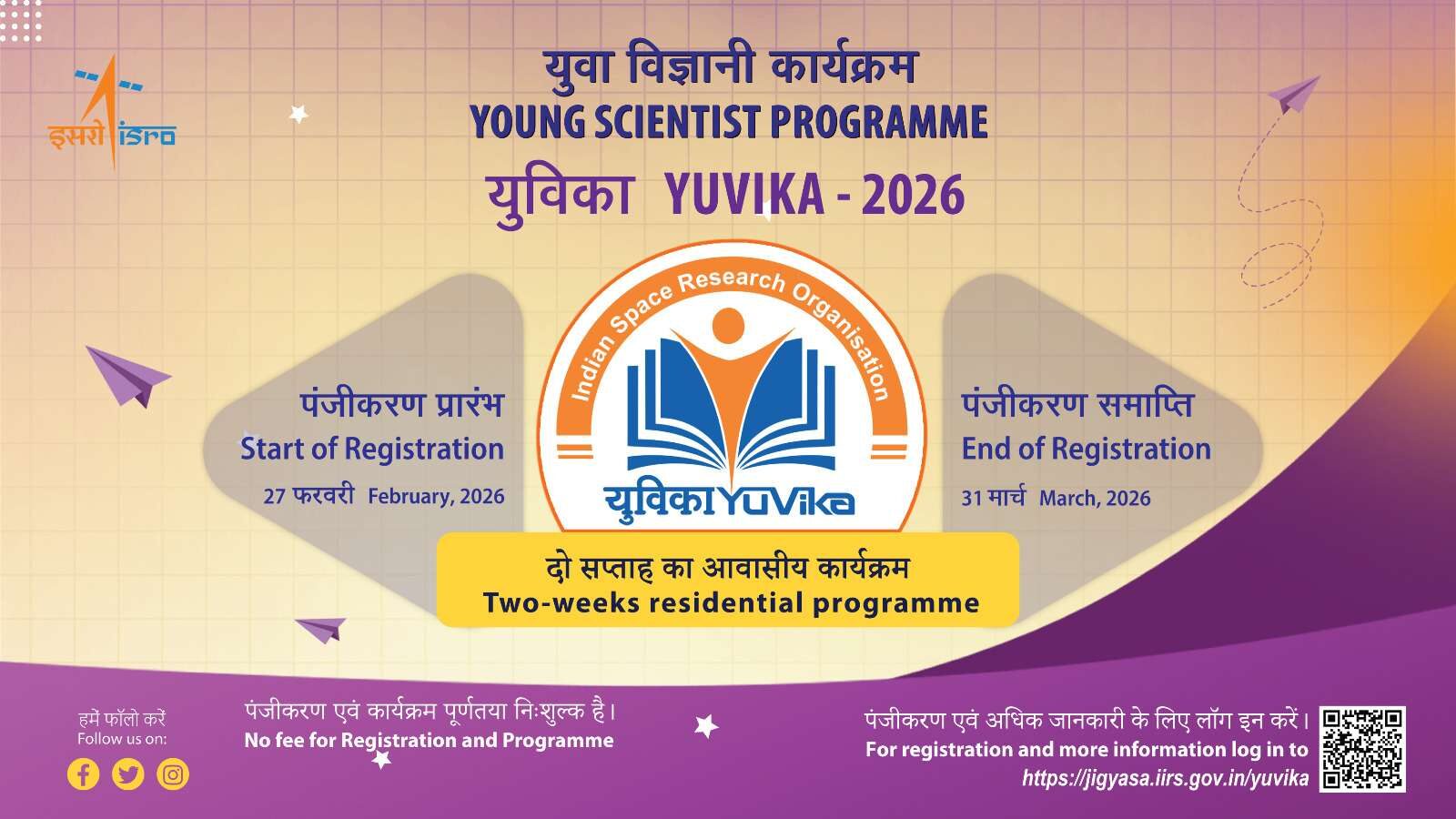
ISRO YUVIKA 2026 Registration Opens: How Students Can Join the Young Scientist Programme

BENGALURUThe Indian Space Research Organisation (ISRO) has officially opened the application window for its highly anticipated YUVIKA (YUva VIgyani KAryakram) 2026 initiative. Aimed at “catching them young,” this prestigious two-week residential program is designed to impart foundational knowledge in space technology, space science, and space applications to school students across India.

With online registrations officially opening on February 27, 2026, eligible Class 9 students now have a golden opportunity to spend their summer holidays learning directly from India’s top space scientists.
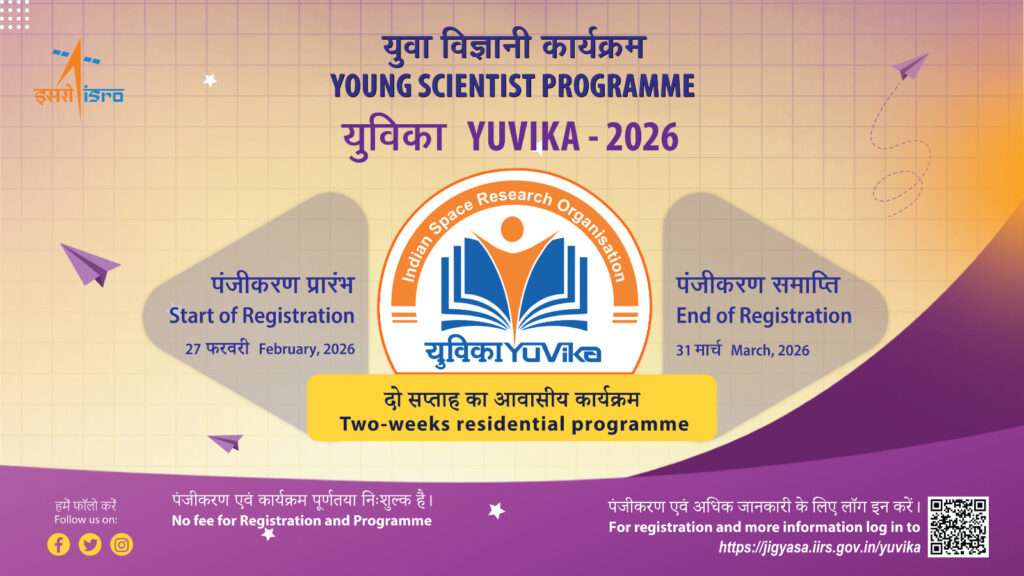
Critical Dates for YUVIKA 2026

Students and parents should take note of the strict timeline for this year’s application process:

  • Online Registration Opens: February 27, 2026
  • Application Deadline: March 31, 2026
  • First Selection List: April 13, 2026
  • Second Confirmation List: April 20, 2026
  • YUVIKA Programme Dates: May 11 to May 22, 2026

The entire program is fully sponsored by ISRO. Selected students will receive free lodging, boarding, course materials, and reimbursement for II AC train fare (or equivalent bus fare) for their travel.

Bridging the Gap Between Theory and Space Reality

The primary objective of the YUVIKA 2026 program is to bridge the gap between theoretical textbook knowledge and practical application. Often, students learn scientific concepts in a vacuum; YUVIKA addresses this by offering immersive, hands-on experiences.

The comprehensive curriculum covers a wide range of topics, including satellite technology, rocket propulsion, space missions, and astrophysics. Hands-on learning is a cornerstone of the initiative. Over the course of the two-week camp—held across 7 to 9 major ISRO centers across the country—participants will build and launch model rockets, design simulated satellite payloads, and interact with experienced scientists and researchers.

Eligibility Criteria and Selection Weightage

To ensure fairness and to attract the most dedicated young minds, ISRO has established a rigorous, multi-tier selection process.

Basic Eligibility: Students must be studying in Class 9 as of January 1, 2026, within a recognized school in India.

The selection is based on a composite score calculated from academic and extracurricular performance. The official weightage for YUVIKA 2026 is as follows:

  • Class 8 Academic Marks: 50%
  • Rural School Student (Panchayat Area): 15% (Aimed at promoting inclusivity)
  • Online ISRO Quiz Performance: 10%
  • Science Fair / Co-curricular Participation: Up to 10%
  • Olympiad or Equivalent Prize (1st-3rd Rank): 5%
  • Scout & Guides / NCC / NSS Membership: 5%
  • Sports Competition Winners: Up to 5%

This holistic approach ensures that not only academically gifted students but also those with a demonstrated, active passion for science and community are rewarded.

Success Stories: The Launchpad for Future Careers

The YUVIKA program has a proven track record of igniting lifelong passions. For example, Ananya Singh, a participant in the 2019 program, credits YUVIKA for sparking her interest in satellite technology; she is now studying at a prestigious engineering institute working on innovative satellite projects. Similarly, Ravi Kumar from the 2020 cohort was motivated by his YUVIKA Mars exploration project to study planetary science, leading to specialized research in Martian geology.

Furthermore, ISRO has forged strong collaborations with leading educational institutions, research organizations, and international space agencies to ensure YUVIKA alumni have continued access to mentorship, internships, and research opportunities long after the two-week camp concludes.

How to Apply

Interested students must complete the multi-step online application process before the March 31 deadline.

  1. Visit the official ISRO Antriksh Jigyasa portal.
  2. Navigate to the “YUVIKA 2026” registration link.
  3. Fill out personal, academic, and extracurricular details accurately.
  4. Submit a brief essay explaining your interest in space science.
  5. Upload the required scanned documents (including a bonafide certificate signed by the school principal).

For young minds fascinated by the cosmos, ISRO’s YUVIKA 2026 is not just a summer camp—it is the first step toward a potential career among the stars.

For detailed guidelines and the application portal, visit the official ISRO website.
Registration Link

aiasc donation
CITIZEN SCIENCE

All India Asteroid Search Campaign: A 15-Year Legacy of Citizen Science and Youth Empowerment

AIASC: A Collaborative Effort Between Space Foundation, IASC, and NASA

The All India Asteroid Search Campaign is conducted by Space Foundation in collaboration with the International Astronomical Search Collaboration (IASC), a NASA citizen science project.

1. Role of Space Foundation

Space Foundation is responsible for organizing the campaign in India, providing participants with training, tools, and data to analyze asteroid images.

2. International Astronomical Search Collaboration (IASC) and NASA’s Role

IASC, an initiative led by Dr. Patrick Miller of Hardin-Simmons University, provides astronomical data from NASA-funded telescopes. AIASC participants receive high-resolution images to analyze and report potential asteroid discoveries.


Participation and How Students Can Get Involved

1. Who Can Participate?

  • School and college students interested in astronomy.
  • Amateur astronomers looking to contribute to scientific research.
  • Teams of two who undergo specialized training.

2. Registration and Training

  • Participants register through the official AIASC portal.
  • They receive training on asteroid detection software, such as Astrometrica.
  • The program includes workshops on data analysis and asteroid tracking.

How Asteroids Are Discovered: Tools and Techniques

1. Data Analysis and Image Processing

Participants receive sequential images of the night sky and use software tools like:

  • Astrometrica: A powerful tool for tracking asteroid movement.
  • NASA’s Asteroid Database: Cross-referencing known asteroids to confirm new discoveries.

2. Reporting and Validation

Once a potential asteroid is identified:

  1. Observations are documented and submitted to IASC.
  2. NASA scientists verify the data to confirm the discovery.
  3. The asteroid may receive a provisional designation and eventually be named if its orbit is consistently tracked.

AIASC Achievements: Asteroid Discoveries by Indian Students

AIASC 2023

1. Notable Discoveries by AIASC Participants

Over the years, AIASC has resulted in:

  • 80+ provisional asteroid discoveries.
  • 2 numbered asteroids officially recognized by the International Astronomical Union (IAU).
  • 11,560 preliminary asteroid detections, awaiting further confirmation.

2. Recent Success Stories in India

School Students Discover 18 New Asteroids (2020)

  • 150 students across India participated in the International Asteroid Discovery Project, organized by STEM & Space in collaboration with IASC.
  • The students’ discoveries were recognized by IAU and added to the Minor Planet Catalog.
  • Source: Tribune India

Indian Schoolgirls Discover Earth-Bound Asteroid (2020)

  • Two teenage girls from India discovered an asteroid slowly shifting towards Earth.
  • Source: BBC News

Pune Students Discover Six Asteroids (2021)

  • Two students from Pune, Maharashtra, discovered six preliminary asteroids as part of the Kalam Centre Asteroid Search Campaign.
  • Source: The Hindu

NASA Recognizes Karnal Student for Asteroid Discovery (2024)

  • Diksha, a Class 11 student from Karnal, Haryana, was recognized by NASA for discovering a Main Belt Asteroid.
  • Source: Times of India

Future of AIASC and Asteroid Research

1. Expansion and Inclusivity

  • AIASC aims to increase outreach to rural schools and colleges.
  • Plans to introduce AI and machine learning for faster asteroid identification.

2. International Collaborations

  • Expanding partnerships with NASA, ESA (European Space Agency), and ISRO (Indian Space Research Organisation).
  • Encouraging global participation in asteroid discovery campaigns.

Conclusion: Inspiring the Next Generation of Astronomers

The All India Asteroid Search Campaign is a testament to the power of citizen science and the potential of young minds in astronomical research. As AIASC continues to inspire and educate, it is shaping the future of space exploration in India and beyond.

With every asteroid discovery, a student takes a step closer to unlocking the secrets of the universe. Whether for scientific research, planetary defense, or future space mining, AIASC ensures that India’s youth remain at the forefront of global space exploration.

Want to be part of the next big asteroid discovery?

Visit Space Foundation and IASC to learn more about how you can participate in AIASC!