




GET IN TOUCH

Sector 11, Dwarka, New Delhi-110075

hello@space-foundation.org

+91-74020 74020 | +91-92126 69953

Tag: EDUCATION

yuvika_flyer_2026
ASTRONOMY FOR DEVELOPMENTCITIZEN SCIENCEISROYOUTH

ISRO YUVIKA 2026 Registration Opens: How Students Can Join the Young Scientist Programme

BENGALURUThe Indian Space Research Organisation (ISRO) has officially opened the application window for its highly anticipated YUVIKA (YUva VIgyani KAryakram) 2026 initiative. Aimed at “catching them young,” this prestigious two-week residential program is designed to impart foundational knowledge in space technology, space science, and space applications to school students across India.

With online registrations officially opening on February 27, 2026, eligible Class 9 students now have a golden opportunity to spend their summer holidays learning directly from India’s top space scientists.
Critical Dates for YUVIKA 2026

Students and parents should take note of the strict timeline for this year’s application process:

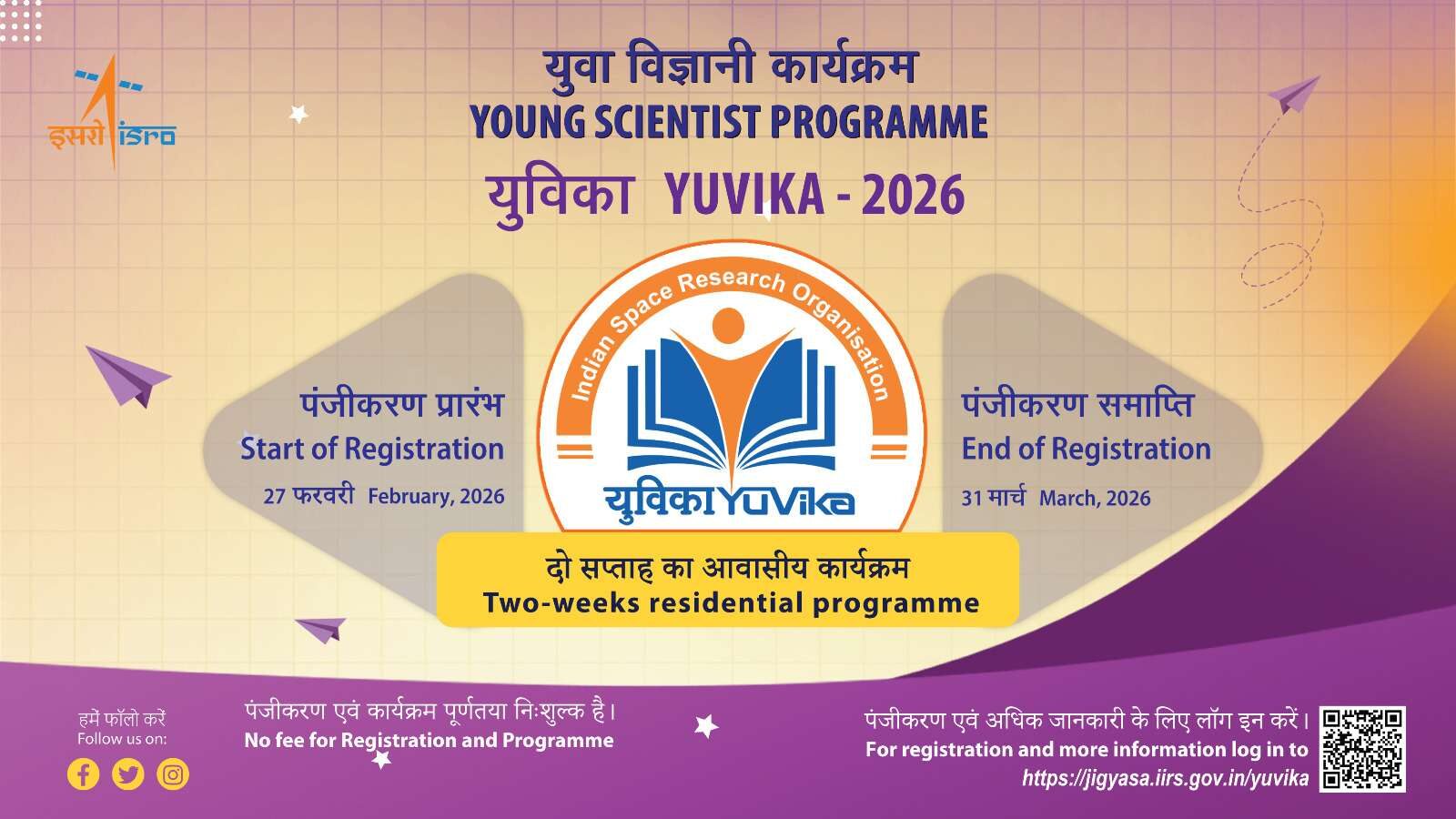
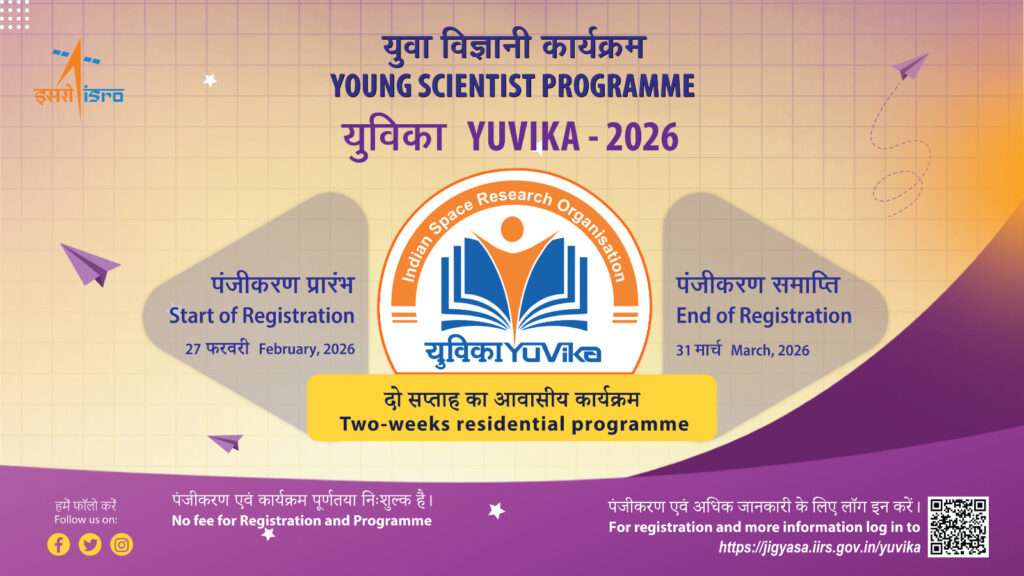
  • Online Registration Opens: February 27, 2026
  • Application Deadline: March 31, 2026
  • First Selection List: April 13, 2026
  • Second Confirmation List: April 20, 2026
  • YUVIKA Programme Dates: May 11 to May 22, 2026

The entire program is fully sponsored by ISRO. Selected students will receive free lodging, boarding, course materials, and reimbursement for II AC train fare (or equivalent bus fare) for their travel.

Bridging the Gap Between Theory and Space Reality

The primary objective of the YUVIKA 2026 program is to bridge the gap between theoretical textbook knowledge and practical application. Often, students learn scientific concepts in a vacuum; YUVIKA addresses this by offering immersive, hands-on experiences.

The comprehensive curriculum covers a wide range of topics, including satellite technology, rocket propulsion, space missions, and astrophysics. Hands-on learning is a cornerstone of the initiative. Over the course of the two-week camp—held across 7 to 9 major ISRO centers across the country—participants will build and launch model rockets, design simulated satellite payloads, and interact with experienced scientists and researchers.

Eligibility Criteria and Selection Weightage

To ensure fairness and to attract the most dedicated young minds, ISRO has established a rigorous, multi-tier selection process.

Basic Eligibility: Students must be studying in Class 9 as of January 1, 2026, within a recognized school in India.

The selection is based on a composite score calculated from academic and extracurricular performance. The official weightage for YUVIKA 2026 is as follows:

  • Class 8 Academic Marks: 50%
  • Rural School Student (Panchayat Area): 15% (Aimed at promoting inclusivity)
  • Online ISRO Quiz Performance: 10%
  • Science Fair / Co-curricular Participation: Up to 10%
  • Olympiad or Equivalent Prize (1st-3rd Rank): 5%
  • Scout & Guides / NCC / NSS Membership: 5%
  • Sports Competition Winners: Up to 5%

This holistic approach ensures that not only academically gifted students but also those with a demonstrated, active passion for science and community are rewarded.

Success Stories: The Launchpad for Future Careers

The YUVIKA program has a proven track record of igniting lifelong passions. For example, Ananya Singh, a participant in the 2019 program, credits YUVIKA for sparking her interest in satellite technology; she is now studying at a prestigious engineering institute working on innovative satellite projects. Similarly, Ravi Kumar from the 2020 cohort was motivated by his YUVIKA Mars exploration project to study planetary science, leading to specialized research in Martian geology.

Furthermore, ISRO has forged strong collaborations with leading educational institutions, research organizations, and international space agencies to ensure YUVIKA alumni have continued access to mentorship, internships, and research opportunities long after the two-week camp concludes.

How to Apply

Interested students must complete the multi-step online application process before the March 31 deadline.

  1. Visit the official ISRO Antriksh Jigyasa portal.
  2. Navigate to the “YUVIKA 2026” registration link.
  3. Fill out personal, academic, and extracurricular details accurately.
  4. Submit a brief essay explaining your interest in space science.
  5. Upload the required scanned documents (including a bonafide certificate signed by the school principal).

For young minds fascinated by the cosmos, ISRO’s YUVIKA 2026 is not just a summer camp—it is the first step toward a potential career among the stars.

For detailed guidelines and the application portal, visit the official ISRO website.

Registration Link

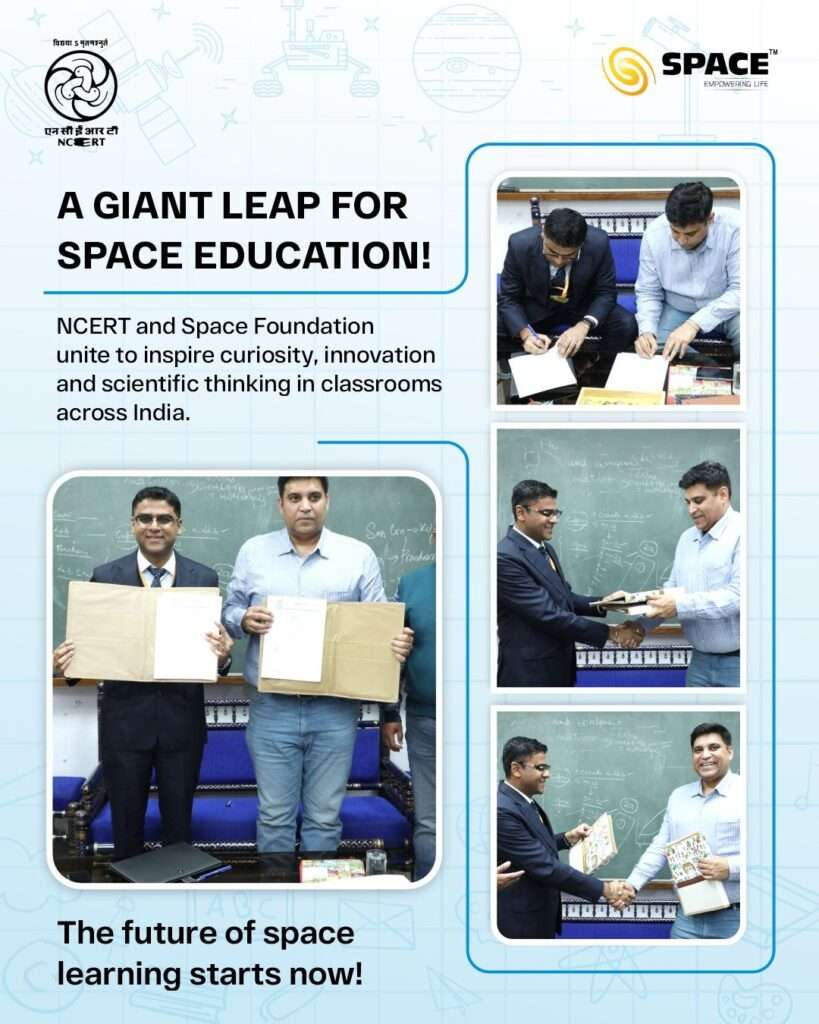
NCERT x Space Foundation MoU
QUALITY EDUCATIONSAMAGRA SHIKSHASDGVIKSIT BHARAT

Space Education Foundation and NCERT Sign Landmark MoU to Boost Astronomy in Indian Schools

NEW DELHI — In a significant move to align Indian school education with 21st-century scientific advancements, the National Council of Educational Research and Training (NCERT) has officially signed a Memorandum of Understanding (MoU) with the Space Education Foundation.

The three-year collaborative agreement aims to weave astronomy, space education, application, and advanced technology into the educational fabric of schools nationwide, fostering a robust scientific temperament among Indian youth.

Aligning with NEP-2020 and National Curriculum Goals

The partnership is strategically designed to accelerate the goals outlined in the National Education Policy (NEP-2020), as well as the latest National Curriculum Frameworks (NCF-FS-2022 and NCF-SE-2023).

By bringing specialized space education out of the periphery and into mainstream learning, the initiative aims to build critical scientific skills and inspire the next generation of researchers and innovators.

According to the official MoU, the collaboration will focus heavily on content development, collaborative learning, and the integration of modern technology into the classroom environment.

Five Pillars of the Space Education Initiative

The joint initiative between the national educational body and the West Delhi-based foundation will operate across several high-impact areas:

  • Digital & Physical Content Creation: The co-creation of specialized educational and training resources tailored for students at various learning levels.
  • Teacher Training (CPD): Comprehensive Continuous Professional Development for educators, equipping them to integrate innovative pedagogy and future-ready tech skills into their daily teaching.
  • Technological Integration: The implementation of adaptive learning tools, mobile applications, and software to modernize teaching, learning, and assessment.
  • Hands-on Scientific Training: Facilitating real-world field training, including the handling of astronomical instruments, scientific observation, and the creation of youth competitions and student internships.
  • AI & Collaborative Research: Joint studies utilizing artificial intelligence and machine learning (AI/ML) for big data management, analysis, and interpretation in astronomical research.

Implementation and Quality Control

To maintain the highest standards of national education, NCERT will spearhead the foundational guidelines and Standard Operating Procedures (SOPs). NCERT will also conduct need-based orientation programs to ensure the Space Education Foundation’s contributions seamlessly integrate into major national digital infrastructure, including PMeVidya, DIKSHA, ePathshala, PRASHAST, and the eJaadui Pitara platform.

The Space Education Foundation will shoulder the responsibility of executing the project’s core objectives. The foundation is mandated to ensure that all new methods, materials, and tech solutions strictly adhere to NCERT’s PRAGYATA Guidelines for Digital Education and e-content development frameworks.

Key Delegates at the Signing

The Memorandum of Understanding was officially signed at the NCERT headquarters in New Delhi. The event was graced by senior officials and leadership from both organizations who are committed to the digital and scientific evolution of India’s curriculum.

Representing NCERT was Sh. Himanshu Gupta, Secretary, NCERT, alongside other esteemed administrators. The Space Education Foundation was represented by Dr. Sachin Bahmba, Chairman, Space Foundation, highlighting the foundation’s dedication to making space science accessible to the masses.

A Vision for Bharat 2047: Founder’s Message

At the heart of this partnership is a deeply rooted vision to democratize space education across India. Speaking on the historic collaboration, the leadership of the Space Education Foundation shared their vision for the future:

“Our mission at the Space Education Foundation has always been to bring the universe closer to our students. By partnering with a premier institution like NCERT, we are not just sharing knowledge; we are building a nationwide ecosystem where young minds can dream beyond the sky. This MoU is a stepping stone toward a future where every Indian classroom has the tools to explore astronomy, fostering the next generation of space innovators and scientists.” — Dr. Sachin Bahmba, Chairman, Space Education Foundation

A Voluntary Push for Science

Notably, the MoU is established as a voluntary, mutually beneficial partnership. It imposes no financial commitments on either party, highlighting a shared, public-service-driven passion for elevating India’s educational landscape.

As India’s space sector continues to make global headlines, this grassroots educational push promises to ensure that the nation’s classrooms are preparing students to lead the next frontier of space exploration.

For more information on participating in these new educational initiatives, schools and educators can explore the Space Education programs.

viksit bharat young leaders dialogue
VIKSIT BHARATYOUTH

Viksit Bharat Young Leaders Dialogue 2025

The Viksit Bharat Young Leaders Dialogue 2025 provides valuable insights into the transformation of India. This event brings together young leaders from various sectors and provides a platform for them to discuss and develop strategies that will shape the country’s future. The dialogue focuses on key areas such as education, healthcare, technology, sustainability, and entrepreneurship.With its emphasis on collaboration and innovation, the Viksit Bharat Young Leaders Dialogue 2025 aims to create a roadmap for India’s transformation.